“The din and the glamour”: Some Treasures of the Grainger Museum and Archives of Interlochen Center for the Arts
By Phyllis Weliver, Saint Louis University
There are secrets in the extensive Grainger Museum holdings, I realized as I explored them through the lens of a sister collection, the Archives of Interlochen Center for the Arts [ARTICA] in Michigan, USA, where I grew up. Both of these impressive stores of unpublished manuscript and rare print material, extraordinary musical instruments and much more, offer mutually enlightening surprises that deepen the stories that we thought we knew. Studying just a few items from each collection can gesture to the depth and consequence of these neglected archives for understanding the history of music composition and music-making within a cultural context.

Figure 1. Ella Grainger to Percy Grainger, 2 July 1943, Grainger Museum.
In the sixteenth summer of the Interlochen National Music Camp (NMC), Ella Grainger wrote a letter to Percy Grainger on stationary that reveals how Interlochen’s resort hotel claimed NMC as “America’s Summer Capital of the Arts”. [Fig. 1.] This slogan (which was repeated on other contemporaneous print material) emerged from the camp’s practice of hiring renowned conductors to work and perform with high school musicians – an innovation that quickly caught on further afield. If you were not one of the ten thousand audience members sitting in Interlochen’s rustic “Bowl” amphitheater to witness Percy Grainger playing and conducting in 1930, 1937, and 1942–44 (fireworks followed in 1937), then you could hear the concerts broadcast nationally on NBC radio. Interlochen was thereby a leader in the musical world, even lending its most famous faculty member to perform elsewhere during the eight-week summer season. The letter that Ella wrote to her husband exemplifies how the couple mostly communicated during Grainger’s exhausting trips during camp (returning from performing in Washington, D.C., he journeyed three days by barge and train), with the comments in red being Grainger’s notes, probably after a phone call. The letterhead further reveals that early Interlochen identified itself as situated on Lake Wabekanetta (today, Green Lake) – an association with the local Odawa people to which I return. In the letter itself, Ella refers to the camp as “The din + the glamour” – the “din” being the constant music-making, and the “glamour” indicating Interlochen’s standing as America’s arts “Capital”. Grainger’s star status can be glimpsed when he headlined a “War Bond Show” in Missouri with Hollywood legend Bette Davis two weeks after camp ended in 1942. [Fig. 2.]
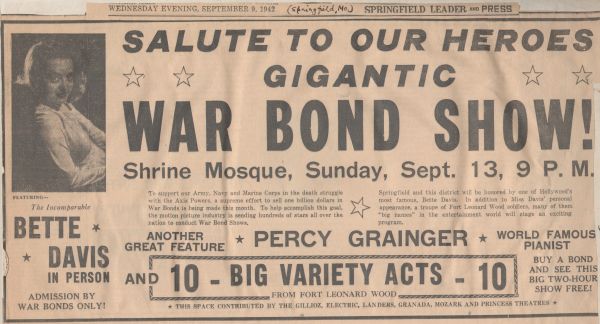
Figure 2. "Salute to our Heroes" advertisement, Springfield Leader (9 September 1942), Grainger Museum.
Modern glamour, the environment, the so-called “Indianist” movement in American art music, and Grainger were associated from NMC’s beginning. In the camp’s second season, Steinway advertised in the weekly concert program book at Interlochen, The Bowl, with full-page advertisements featuring a reproduction of Everett Henry’s painting, “An Interpretation of Percy Grainger’s ‘Colonial Song’.” [Fig.3.] Craig H. Roell notes that Steinway advertising in the 1920s featured modern art to communicate its artistic prestige.[1] Grainger’s celebrity appeal assisted this luxe branding (Steinway was Grainger’s chosen piano, the text asserts), but so, too, did Henry’s art deco style communicate the glamour of Grainger as composer. An angular cubist style combined with a rural setting suggests that cultured, modern music was rooted in wild countryside.
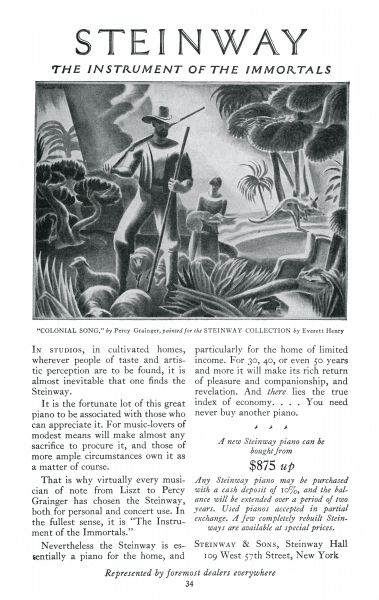
Figure 3. Steinway advertisement, Interlochen Bowl: Program Season 1929 (30 June 1929): 34. Photo copyright ARTICA - The Archives of Interlochen Center for the Arts; used by permission.
This Steinway advertisement gained particular resonance within the pages of Interlochen’s program booklet for 1929. Each week’s Bowl featured the same cover in 1929: a fanciful depiction of the local Odawa and Ojibwe people who appear to be observing a concert in the Bowl. [Fig. 4.] Like the Steinway advert, this cover made the connection between musical culture and settler colonialism explicit with this visual interpretation of “The Legend of Our Lakes and Forests” by M.E. Maddy, the mother of Interlochen’s president and co-founder, Joseph E. Maddy. “This was hotly contested territory between the Chippewas or Ojibways and the Ottawas [Odawa]”, states the legend, which then presents an “outline of the dim past of the territory where this present summer camp is located”. Its conclusion – “as strangers wander through the many beautiful paths, perhaps if they listen hard enough, they may catch a faint singing of a speeding arrow in the whispering pines” – directly contradicts the image, which seems to be presented from the perspective of the listening tribal peoples, but according to the legend, is actually how concert-goers might contextualize their experience of hearing cultured music within a local history and topography. What NMC was communicating in this legend (rendered visually and verbally) was specifically an Americanist experience of music.[2]
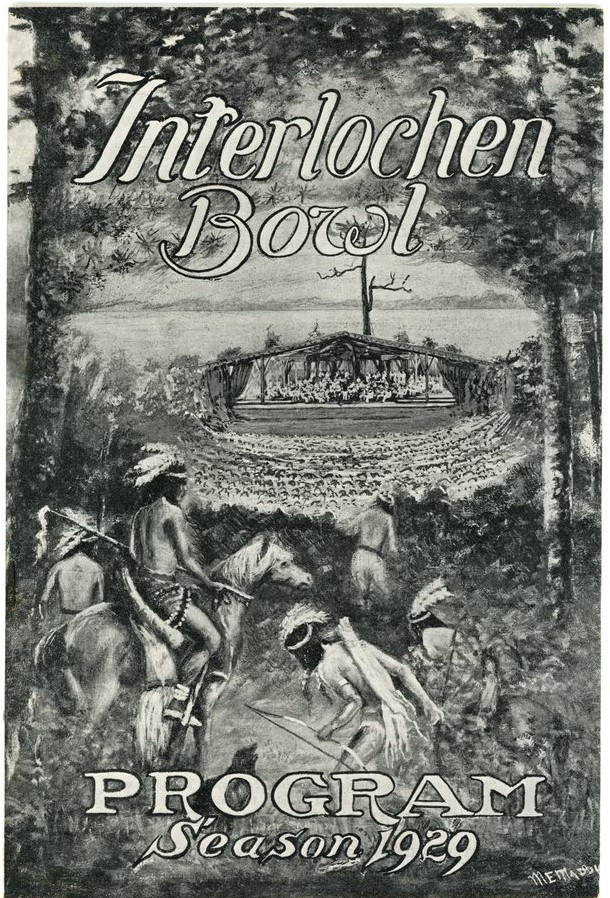
Figure 4. M.E. Maddy, “The Legend of Our Lakes and Forests”, Interlochen Bowl: Program Season 1929 (30 June 1929): 46. Photo copyright ARTICA - The Archives of Interlochen Center for the Arts; used by permission.
Grainger himself connected the dots between Interlochen and “Indianist” composition when, in his first season as NMC camp faculty (he conducted the band), he made a substitution on the program for the 1 August 1937 concert and Sunday broadcast. The archives record both the originally planned concert and, through Grainger’s annotations, what was actually performed. [Fig. 5.] I am particularly interested in Carl Busch’s “A Chant from the Great Plains”, for Grainger’s program note reveals what he admired about the piece:
"Carl Busch […] is one of those few composers who fully understand the colorful possibilities of the modern symphonic band + write for it accordingly. 'A Chant from the Great Plains' is his finest + most ambitious composition for this medium. This Symphonic Episode has been inspired by an Indian scene typical of the early life of the West". [Fig. 6.]
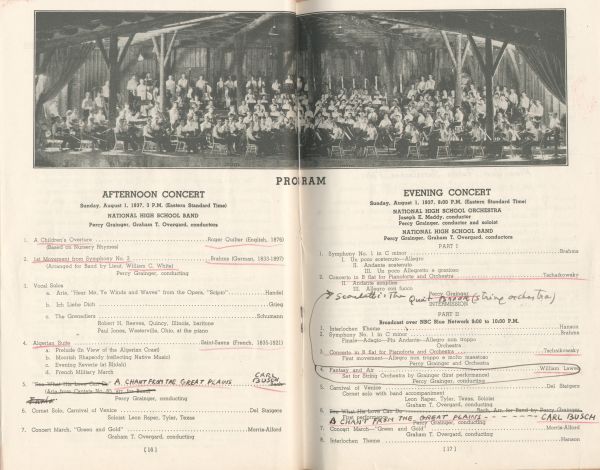
Figure 5. Concert program annotated by Percy Grainger, The Weekly Scherzo (1 August 1937), Grainger Museum.
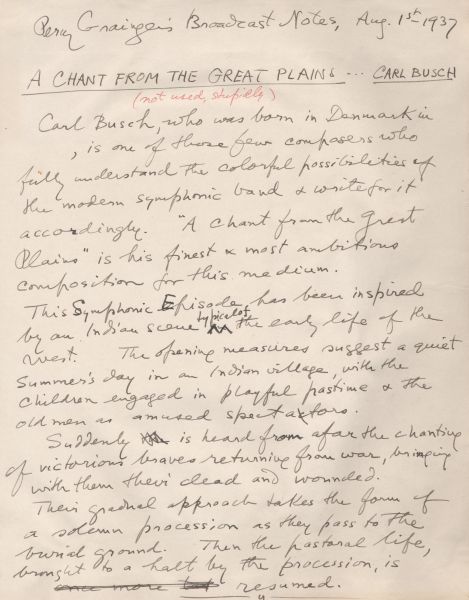
Figure 6. Percy Grainger, [Interlochen] Broadcast Note for Carl Busch’s A Chant from the Great Plains, 1 August 1937, Grainger Museum.
Grainger then went on to paraphrase the words found on the score’s title page.[3] This “Descriptive Note” reveals that Busch’s Chant was the prize-winning entry for the Edwin Franko Goldman band composition of 1920, judged by Grainger and Victor Herbert. For seventeen years, Grainger had thus championed a composer who found inspiration in the songs collected from America’s First Nations, and who understood “the subtle tonal palette of the military band” as he expressed to Goldman.[4] The result? The “finest” “modern symphonic band” writing, to Grainger.
If I have been able to piece together from a handful of items that Grainger championed American music of a certain type at Interlochen, which itself participated in a wider idea of modern glamour, then just think how much more exists within the Grainger Museum and ARTICA. Grainger’s Interlochen connections were so deep that, in pursuing them, a different organizing structure emerges to the Grainger Museum materials from 1930 to the 1950s. The Grainger and Interlochen collections even explicitly work together, for Grainger preserved much Interlochen institutional history that is not found in ARTICA, as seen in his annotated programs. Reciprocally, ARTICA’s materials reshape our understanding of Grainger during years that he later neglected when reassessing his career due to painful illness, isolation and a bitter sense of failure – a disregard that scholarship has followed, to its detriment. Widening out to a third archive, the Interlochen Center for the Arts Records under the custodianship of The University of Michigan’s Bentley Historical Library (ARTICA maintains the copyright), include a notable Grainger correspondence, virtually ignored by researchers. Beyond additional findings for topics such as the “Indianist” movement in American classical music and the burgeoning wind band repertoire, exploring a wider, contextualized history also repositions today’s understandings of significant individual and institutional educational achievements. These include Grainger’s important contributions to Interlochen’s unusual approach to music education, which proved inspiring to Ruth Alexander and John Bishop who established the National Music Camp Association in 1948 for Australia’s youth, explicitly modelled on Interlochen’s National Music Camp. However, I believe that’s a story for another day.
[1] Craig H. Roell, The Piano in America, 1890–1940 (Chapel Hill: University of North Carolina Press, 1989) 78.
[2] For Americanism in composition, see Barbara A. Zuck, A History of Musical Americanism (Ann Arbor: UMI Research Press, 1978).
[3] Carl Busch, A Chant from the Great Plains (New York: Fischer, 1920).
[4] Percy Grainger to Edwin Franko Goldman, [n.d.], Royal Library, Copenhagen. Cited by Donald R. Lowe, Journal of Band Research 14.1 (1978): 16–20 (18).