Re-Hearings of the Music of Florence Donaldson Ewart
By Faye Patton
On 13 February 2023 Florence Donaldson Ewart’s Piano Prelude 3 was heard in a BBC3 radio program Mindful Music.
Piano Prelude No 3. Mindful Mix, BBC 3 (2023). Jeanell Carrigan, Australian Heritage Vol 1, Wirripang Pty Ltd, 2016. Used with permission.
The program included Australian composers Peggy Glanville-Hicks and Peter Sculthorpe alongside selected instrumental works of Bach, Handel, Haydn, Clara Schumann, Chopin, Grieg, d’Indy, Germaine Tailleferre, Erik Satie, Delius, Philip Glass and others.
British-born Florence Donaldson Ewart (1864–1949) arrived in Melbourne in 1906, an experienced solo violinist and conductor (she had established her own orchestra in Birmingham in the 1890s), with an almost complete opera and several vocal works. Ewart had been trained in London, mentored by Adolph Brodsky in Leipzig and studied with Joseph Joachim in Berlin. In Melbourne she quickly gained a reputation as a highly accomplished composer. Over four decades her works appeared regularly in concerts and recitals for music and literature societies, conservatoria, radio broadcasts, occasional civic events and celebrations.
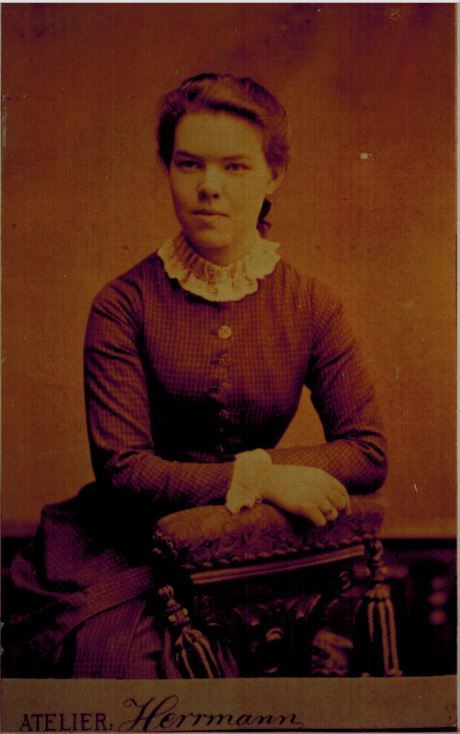
Florence Ewart as a student in Leipzig c.1883
In 1953, four years after her death, her sons Ulex and Konrad Ewart gifted to the Grainger Museum her unpublished MSS, a collection of eighty-four titles.
The Ewart Collection reveals a highly productive composer of five operas, a symphonic poem, a ballet, a string quartet, and a collection of diverse vocal and instrumental genres: choral and chamber, organ and piano, dramatic and brass band works and songs for voice and piano - with multiple arrangements, amounting to hundreds of pen-and-ink pages in Ewart’s hand.
In October 1932 Florence Ewart’s song The Pool (Alexander Gordon Steven) was part of a live-to-air broadcast over Australian Broadcasting Commission national radio—which had begun transmission only three months earlier. Radio audiences in the early 1930s also heard live-to-air studio performances of her String Quartet in D minor, excerpts of her third opera The Courtship of Miles Standish, as well as piano works and songs over both 3LO and 3AR networks.
Several works retrieved from the Ewart Collection are today available in digital formats and can be heard as audiences heard them almost 100 years ago:
- Preludes 1, 2, and 3, and Sequence (MG5/17-11:8) in Piano Music by Australian Women, Australian Heritage Collection, Volume 1, 2016
- The Thought (MG5 /17-8) in Woman’s Song: Song by Australian Women Composers 1994
- The Song of the Gumleaf (MG5/17-9-5), published in 2021 as a YouTube video
Piano Prelude 2
Florence Ewart’s three Preludes and Sequence—her only pieces for piano—were composed in the late 1920s. Struck by performances of Debussy’s music in Paris in 1921, she had spent four years studying composition in Italy and Paris. In the three preludes Ewart was exploring—in concentrated form—a new musical idiom. In these she had assimilated the flexible melodies, less conventional harmony and abrupt changes in texture she had heard in Debussy’s music.
John Simon performed Prelude 1 in 1932 at the University Conservatorium and the Melbourne Town Hall, and in a live radio performance. Ada Freeman (Ada Corder 1895–1987) performed all three preludes in 1934 for an ABC national broadcast.
In Prelude 2 the parallel right hand 4ths and 5ths of the opening bars (repeated at the end), a more nuanced harmonic style and fluid rhythm are impressionistic and contrast with the opening (and closing) sweeps of melody of Prelude 3. Prelude 2 concludes on a subdued ‘unfinished’ seventh.
Piano Prelude No. 2, Jeanell Carrigan, Piano Music by Australian Women, Australian Heritage Collection Volume 1, Compact Disc, Wirripang Pty Ltd, April 2016. ISMN 979 0 72066 92 6. Used with permission.
The Thought
In the early 1930s, Ewart’s search for literary modernism in her songs had led her to the enigmatic pastoral poetry of Mary Webb (1881–1927), known then to the British public in the songs of Bernard Naylor (On Burning Ploughlands, 1928), Michael Head (Foxgloves, 1933) and Edmund Rubbra (In Dark Weather, 1933).
Composed in 1932, The Thought was performed for the Australian Literature Society, and the Standard Players Society (the poetry read by novelist and literary critic Vance Palmer, 1885–1959), the Music Teachers Association (with Ewart at the piano), and in 1932 and 1933 in live-to-air programs over 3LO and 3AR, performed by Dora Zivin and Muriel Cheek.
Webb’s cryptic image reflects the modernist trend towards fragmentation and brevity.
The Thought, Mary Webb, 1928
As the pale moth passes
In the April grasses,
So I come and go,
Softlier than the snow.
Swifter than a star
Through the heart I flee,
Singing things that are
And things that cannot be.
I whisper to the mole
And the cold fish in the sea,
And to man’s wistful soul
God sendeth me.
As a grey moth passes,
In October grasses,
So I come and go,
Softlier than the snow.
The precisely calculated piano accompaniment—a filigree of ‘flickering’ left and right-hand piano 4ths and 5ths (reversed for the ending)—is a musical image of Webb’s cryptic metaphor. Ewart’s delicate, translucent setting is captured by Helen Noonan in her sleeve notes for Woman’s Song:
‘The Thought is a lovely example of her work—the words and music blend like spun sugar’.
The Thought, Helen Noonan, (soprano) and Peter Locke (piano), Woman’s Song: Songs by Australian Women Composers, CD, Newmarket Music, Kensington, Vic, 1994. Used with permission.
Today Ewart’s four piano works can be streamed on Spotify (Nostalgia: Piano Music by Australian Women, Jeanelle Carrigan, 2016) and mp3s of Ewart’s The Thought and Australian Cradle Song are accessible online from the Australian Music Centre. Australian Cradle Song (1926) is also available on the CD Repose: Lullabies and Cradle Songs by Australian Composers, 1890–1999 (Move Records, 1999).
The Song of the Gumleaf
The Ewart Collection has ten distinctively Australian works spanning 1907 to 1940: a patriotic choral ode for voice and orchestra, three anthems for brass band and a group of six settings of Australian poets. Ewart’s My Country (1924) appears to be one of the first settings of Dorothea Mackellar’s Core of My Heart (1911). These and Ewart’s Australia, An Anthem were performed at the Wembley Exhibition, London in 1925. At the London Writers Club in 1926, Ewart’s The Old Black Billy Winks at Me (The Old Black Billy an’ Me, Louis Esson) baffled the vice regal host who asked for an explanation of exactly what a wallaby was.
Subtitled ‘An Emblem of Australia’ and dedicated to the ‘Officers and Men of the RAAF’ Ewart’s The Song of the Gumleaf was composed on the eve of Australia’s deployment to the Middle East in 1940 and performed on International Women’s Day, 8 March 1940. The quick march with its syncopated 12 bar introduction, vamp rhythm, narrow melodic range and a more lyrical second verse typical of brass band marches, effectively channels patriotic sentiment in a time of war. Sheet music for solo voice and piano was sold as a fundraiser for the RAAF Locker Room.
The text, composed for the occasion by artist and poet Ethel Carrick Phillips-Fox (1872–1952), establishes the gum leaf as a national symbol:
I’ll sing you a song of a gum leaf,
Of a leaf that is tough and true.
Emblem of those who are fighting,
Fighting for me and for you.
CHORUS
So wear a gum leaf, just a gum leaf
Wear a gum leaf on your coat today.
Then post it in a letter,
They’ll ask for nothing better
Will the 'Boys’ when they’re far away.
In true patriotic style, Ewart’s anacrusis 'So wear a gumleaf'—accented and forte—leads to the rousing chorus, an upbeat reminiscent of the popular first world war song It’s a Long Way to Tipperary. As in Ewart’s song settings, words and tune are perfectly in sync.
Performed by Oakleigh Brass on International Women’s Day, 8 March 2020, Florence Ewart’s Song of the Gumleaf was the first of five annual IWD performances of brass band works by Australian women composers published on YouTube.
The Song of the Gumleaf , Oakleigh Brass Band. Used with permission, Oakleigh Brass, Victoria, Australia.