Percy Aldridge Grainger and the Sea Chanty Settings: A Study in Music, Design, and Folk Tradition
In Semester 2, 2025, graduate students Leah Ferguson, Christina Chow, and Jessica Alderton undertook a collection-based research project at the Grainger Museum as part of their Master of Art Curatorship capstone, developing a concept and design for a future exhibition. Drawn to the recurring theme of the sea in Grainger’s collection, their research uncovered an array of objects, including photographs, handmade ropes, drawings, and sheet music covers that illustrate Grainger’s lifelong fascination with the sea. The essay below outlines their findings.
Percy Aldridge Grainger and the Sea Chanty Settings: A Study in Music, Design, and Folk Tradition
Percy Aldridge Grainger (1882–1961) stands as one of the key figures in twentieth-century music and design. An explorer of sound, image, and identity, Grainger blurred the boundaries between composer, collector, designer, and performer. His Sea Chanty Settings and recordings and notation of works such as Shallow Brown, Shenandoah, and Stormy, reveal the vast collecting, collating, composing and designing he enacted. In the objects and ephemera around Sea Chanties from the collection, Grainger’s fascination with the sea, his passion for folk traditions, and his inventive visual imagination are clear.
Born in Melbourne in 1882, Percy Grainger grew up in a household steeped in art, literature, and music.1 His mother, Rose, home-schooled him, nurturing an early appetite for learning and creativity. Their home was filled with books, reproductions of classical sculpture, and an atmosphere of intellectual curiosity that shaped his development. His father, an architect, exposed him to the discipline of design and structure, qualities that would later emerge in the intricate layout of his musical scores.
As a child, Grainger lived near Melbourne’s Albert Park Lagoon. The interplay of wind, water, and movement in that maritime environment left an indelible impression on his imagination. The rhythms of waves and the cries of gulls inspired his lifelong fascination with natural motion and fluidity, ideas that eventually crystallized in his theories of ‘Free Music’, where sound would emulate the continuous flow of nature rather than the fixed pitches of traditional notation.
Grainger’s early artistic training included drawing lessons with the painter Frederick McCubbin, one of the leading figures of the Heidelberg School. These lessons encouraged a sensitivity to line, texture, and balance principles that later infused his visual designs for musical manuscripts. Even as a young student, he built model boats, sketched seascapes, and found in water a metaphor for both freedom and order. This synthesis of visual and sonic awareness would become a defining feature of his creative life.
Although known primarily as a composer and pianist, Grainger’s creativity extended far beyond the concert hall. His manuscripts and published scores often became places for artistic experimentation and design. By the time he began designing his Sea Chanty Settings around 1917, Grainger was crafting covers and title pages that displayed meticulous attention to visual form. His use of ink and watercolour on paper, coupled with a flair for geometric lettering, reflected an emerging Art Deco sensibility.2
The cover design for Shallow Brown (1927), with its curves and lines, demonstrates his integration of visual and musical aesthetics. The written score itself was a visual embodiment of the music’s motion. Grainger’s fascination with design extended to every stage of production from the decoration and binding of scores, to the writing of the notes. In this sense, he treated each composition as a total artwork, where music, typography, and image were a whole.
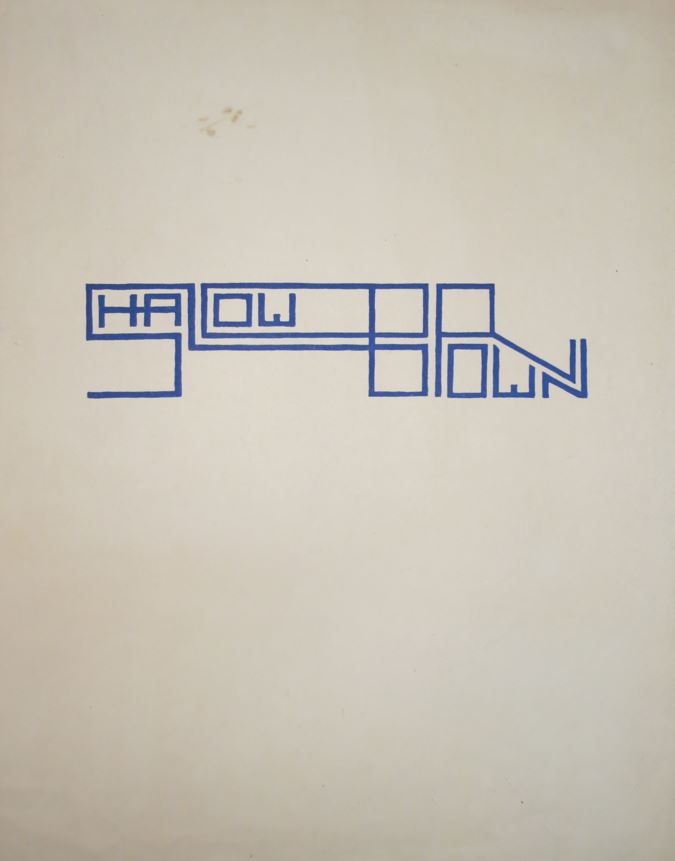
Percy Grainger, cover design for 'Shallow Brown' [not dated], GM 01.2058.9
For Grainger, the sea chanties provided a particularly rich starting point for this visual-musical fusion. The subjects—sailors, voyages, departures, and returns—that the songs were about, mirrored his own sense of movement and restlessness.3 Grainger’s engagement with folk song was driven by curiosity. Beginning in 1905, he undertook extensive fieldwork across Britain and Scandinavia, often carrying a phonograph to record the voices of rural singers, sailors, and labourers.4 This pioneering use of technology placed him among the earliest ethnographic sound collectors.
He valued the individuality of each singer, the dialect, phrasing, and expressive nuance that brought a song to life. In his 1908 article ‘Collecting with the Phonograph’, he described the device as a tool for preserving the ‘truthful dynamics of performance’, capturing details that transcription alone could not convey.5His careful attention to the positioning of singers and the mechanical limits of the recording horn reflected both scientific precision and deep respect for his subjects.
Among these recordings was ‘Shallow Brown’, collected from the deep-sea sailor John Perring of Dartmouth in 1908. The song’s haunting refrain of farewell ‘Shallow Brown, I’m bound to leave you’ spoke to Grainger’s fascination with love, loss, and the vast emotional geography of the sea.6Between 1917 and 1918, he transformed the chanty into one of his most moving settings, scoring it for voice and an ensemble that could include guitars, mandolins, harmonium, or strings. This flexible instrumentation reflected his democratic vision of music: that beauty could be created by any combination of available sounds, regardless of social or professional boundaries.
In Shallow Brown, Grainger sought to embody the ebb and flow of human emotion against the immensity of the ocean. The visual presentation of Shallow Brown reinforces this idea. His hand-drawn lettering, echoing the curve of waves, transforms the visualises the flow of the score. Incorporating an interest to preserve a ‘clear line’ in music into the clear lines of design.7
The sea remained a constant companion in Grainger’s life, both real and symbolic. During his 1933–34 voyage aboard the L’Avenir with his wife Ella, he filled sketchbooks with images of shipboard life, sailors at work, ropes and knots, the changing play of light across the deck.8He also became adept at maritime crafts, weaving intricate knots and experimenting with rope patterns that mirrored his compositional interest in interlacing rhythms.
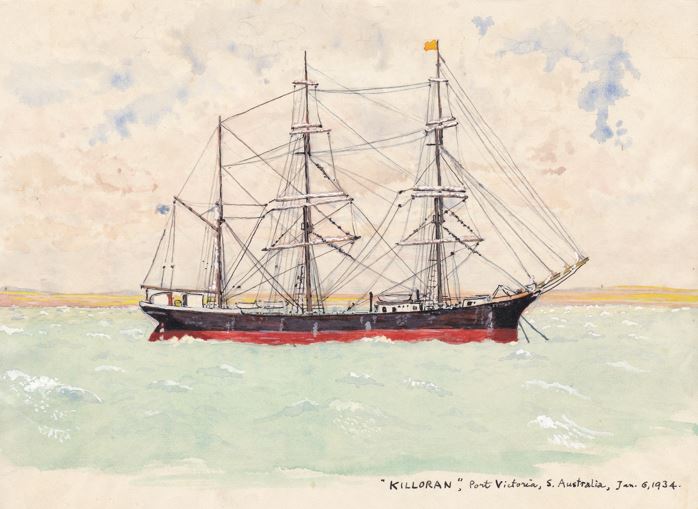
Percy Grainger, 'Killoran', Port Victoria, S. Australia, watercolour, 1934. GM 04.0216
For Grainger, knot-making, like music, could embody structure and freedom together. These creative pursuits were not separate from his musical practice but formed part of a unified vision of art as lived experience, and a sense of a whole art form, a Gesamtkunstwerk.
Grainger’s attraction to folk song was rooted in a belief that such music expressed a kind of purity, an unmediated link between humanity and nature. He was influenced by the transcendentalist writings of Walt Whitman and by his own romantic ideal of the ‘free spirit’, unconfined by academic rules.9To him, the songs of sailors and peasants were not relics of the past but symbols of universal emotion and spiritual vitality.
This view placed him apart from many of his contemporaries. He saw in these songs a bridge between art and life, individual and community. As Anne-Marie Forbes has observed, his folk-song settings ‘opened a door into the musical souls of all humanity’.10The Sea Chanty Settings exemplify this belief: they are both personal expressions and communal celebrations, at once modern compositions and echoes of timeless traditions.
Grainger’s creative process reveals an artist for whom design and music were inseparable. He was meticulous about the physical presentation of his scores, and saw the paper, ink, and binding as integral components of meaning. His decorated manuscripts, often bound by hand, were accompanied by explanatory notes, diagrams, and colour studies show a mind deeply engaged with the tactile realities of creation. Through his Sea Chanty Settings, these tensions found resolution in art that honoured both tradition and innovation. Exploring multitudes of creative representation in his recording and presenting of this work.
By Leah Ferguson, Christina Chow and Jessica Alderton (Master of Art Curatorship, 2025)
1 Biographical information from Teresa R. Balough, The Life and Work of Percy Aldridge Grainger: Till Life Become Fire (Newcastle-upon-Tyne: Cambridge Scholars Publishing, 2023).
2 Elinor Wrobel, Percy Grainger and the Sea: From Water, Wind and the Sea Evolved the Soundscapes of Percy Grainger’s Mind (Parkville: Grainger Museum, 1998), 12.
3 Wrobel, Percy Grainger and the Sea, 14.
4 Anne-Marie Forbes, ‘Notions of the Universal and Spiritual in Percy Grainger’s Early British Folk-Song Settings’, Nineteenth-Century Music Review 16, no. 1 (2019): 43–44.
5 Percy Grainger, ‘Collecting with the Phonograph’, Journal of the Folk-Song Society 3, no. 12 (1908): 148.
6 Balough, The Life and Work of Percy Aldridge Grainger, 107.
7 Forbes, ‘Notions of the Universal’, 72.
8 Wrobel, Percy Grainger and the Sea, 14.
9 Forbes, ‘Notions of the Universal’, 43–44.
10 Forbes, ‘Notions of the Universal’, 43.